I first came across Bill Bryson's work with his Notes from a Small Island, his impressions of England, warts and all, when he first visited us. I found his humorous style to my liking and read his following books with increasing disappointment. By the time I reached A Walk in the Woods I had just about had enough. He was, I felt, trying too hard and his humour was falling flat.
He is, of course, an American but has now made his home in our country. Indeed, he is almost an honorary Englishman and is President of the Campaign to Protect Rural England. It is in that capacity that he has edited a volume of essays entitled Icons of England. Numerous celebrities have contributed short (sometimes very short) essays on what they see as an icon of England. The subjects range "from pub signs to seaside piers, from cattle grids to canal boats" (I copied that from the blurb). Having read the book, I was a little surprised, but gratified, that there had been no mention of those old clichés such as the white cliffs of Dover, policemen's helmets, London buses or Big Ben. But what, I wondered, would I have written about had I been asked to contribute?
My first thought was village war memorials. Most of the war memorials in this country are English in that they are understated, unlike to flamboyant memorials seen in so many French villages. That understatement makes them, to my mind, particularly English. What is more, they record both the great and the small without differentiation. Arthur Brown or John White might have been factory hands, farm workers, shop assistants or sons of the local squire with no need to earn a living: they are all recorded for posterity in exactly the same way.
But then I thought again. One of the icons in the book was the dawn chorus. Can an icon be aural, I wondered? Well, if it can, that makes my decision easy. My icon of England is Nimrod, from Elgar's Enigma Variations. This is quite possibly the most moving piece of music I have ever heard and, to me, is just so expressive of the rolling English countryside, especially the South Downs. I have listened to several versions on YouTube and selected what I consider to be a very good one with the London Symphony Orchestra conducted by Sir Colin Davis.
Thursday, 31 March 2011

Wednesday, 30 March 2011
Do they really know what they are doing?
The politicians, I mean. OK, so nationally we have a bit of a financial problem and I fully agree that this needs to be sorted sooner rather than later. It is certainly not something I think we should be leaving for future generations to deal with. But I also think we should be wary of cutting too deeply in our expenditure, in particular, our expenditure on the defence of the realm. Britain's last aircraft carrier, HMS Ark Royal, is now out of commission and the Harrier jets that flew from her are in the process of being scrapped. It has also been announced that the RAF will be faced with a reduction in manpower of (I think) in the region of 12.5%. Already some pilots in the course of training have been told they are being made redundant. This at a time when we are heavily embroiled in Afghanistan and look like being so for years to come. On top of this, our Government has pushed for, and taken a leading role in enforcing, a no-fly zone over Libya. In connection with all that, it was instructive to read a report in yesterday's newspaper that we have in this country just 69 trained pilots for its Typhoon planes that are currently the mainstay of the RAF. Those 69 include trainers but they have now been drafted to front-line positions and no further training on this aircraft can be undertaken. Of those 69 pilots, 18 are currently at a base in Italy enforcing the flying ban over Libya but the squadron is due to be rotated in a few weeks' time. Of the rest, 24 are committed to the Quick Reaction Alert protecting Britain’s air space and 12 are in the Falklands in a similar role. That leaves only 15 to replace those currently based in Italy.
When the Strategic Defence Review was completed we were assured that our armed forces - even in their slimmer state - would be sufficient to safeguard Britain's world-wide interests. Yet here we are, just months later, and already we are facing problems.
I ask myself again: do our politicians - of any party - really know what they are doing?
All of this leads me to ponder another point. It seems it is now the done thing for us (and other countries) to go by force of arms to the assistance of oppressed peoples in other countries, such as Iraq and Libya. But the people of Zimbabwe have been suffering for many years under that despot Mugabe and nobody has done anything. Am I being overly cynical when I make the point that Zimbabwe has no oil reserves?
When the Strategic Defence Review was completed we were assured that our armed forces - even in their slimmer state - would be sufficient to safeguard Britain's world-wide interests. Yet here we are, just months later, and already we are facing problems.
I ask myself again: do our politicians - of any party - really know what they are doing?
All of this leads me to ponder another point. It seems it is now the done thing for us (and other countries) to go by force of arms to the assistance of oppressed peoples in other countries, such as Iraq and Libya. But the people of Zimbabwe have been suffering for many years under that despot Mugabe and nobody has done anything. Am I being overly cynical when I make the point that Zimbabwe has no oil reserves?
Tuesday, 29 March 2011
Mass Observation
Way back in the 1930s volunteers were recruited to write diaries of their day-to-day experiences, their thoughts and observations of other people's comments. These diaries were then sent to an organisation known as the Mass Observation Unit. Some time ago I read a book which was an edited version of the diaries kept by several of the correspondents during the Second World War. I recently came across another book covering the diaries of five "observers" during the period immediately after the war and I have now nearly finished reading it. Fascinating it is, too. Some of the comments by the writers are really outrageous, some frankly puerile. Their thoughts on what the future then held are interesting but more interesting still are their comments about their everyday lives - the food and fuel shortages, the strikes, their dealings with German prisoners of war still awaiting repatriation.
What a pity there is nothing similar for earlier periods such as the late 19th century or the years after the First World War.
Now I must dash off to meet the auditors for the Lions Housing Society who have finished their work and produced the annual accounts. I have had a copy emailed to me and I must say they do look good. We don't set out to make a profit but somehow we seem unable to do otherwise. The figure for the year ended 31 December last is no less than £175,000. All the reserves which are building up (currently some £455k in bank balances) will eventually be ploughed back into the provision of affordable housing for those who need it, such as the elderly and key workers.
Then this evening I will be at the zone meeting. Who says retirement is boring?
What a pity there is nothing similar for earlier periods such as the late 19th century or the years after the First World War.
Now I must dash off to meet the auditors for the Lions Housing Society who have finished their work and produced the annual accounts. I have had a copy emailed to me and I must say they do look good. We don't set out to make a profit but somehow we seem unable to do otherwise. The figure for the year ended 31 December last is no less than £175,000. All the reserves which are building up (currently some £455k in bank balances) will eventually be ploughed back into the provision of affordable housing for those who need it, such as the elderly and key workers.
Then this evening I will be at the zone meeting. Who says retirement is boring?
Monday, 28 March 2011
Catching up on the reading
I never seem to have as much time as I would like to devote to reading. Before I retired I read much more than I do now, but then I was commuting to London by train so much of the journey was spent with my head in a book. While I wasn't dozing, that is. Anyway, it is when we are in France that I really get an opportunity to pig out. I always take a great pile of books and frequently find I've not taken enough! One of the books I read last week was on the recommendation of The Broad. By coincidence, I visited our local library just a few days after she posted that on her blog and there on the shelf were all three volumes of the trilogy. Biographies are not normally my cup of tea but I decided to borrow the first volume, partly because I was intrigued by the concept of a "fictional biography". I also enjoy much of Beethoven's music so I had an interest in the subject. I was a little surprised how easy a read the book turned out to be. Despite its length (What is it - 400 or 500 pages?) I finished it in a very short time - and thoroughly enjoyed it. I hope the other two volumes are still on the shelf when I next visit the library.
(I'm too mean to buy books and nearly always borrow them.)
(I'm too mean to buy books and nearly always borrow them.)
Sunday, 27 March 2011
Back in the swing
So we got back to Brighton yesterday evening, rather later than we had hoped. The journey from La Prévière to Calais went pretty much without a hitch - just a patch of murk and rain between Boulogne and Calais. Pity the journey down hadn't been so good. The Old Bat shares the driving with me and during her stretches at the wheel I generally read. Two reasons for this: 1. I get bored with just looking out of the window at what is, for much of the time, uninteresting scenery, and 2. it saves me from biting my fingernails and complaining about her driving. This, however, can lead to upsets, as we found to our (my) cost. She drove straight past the motorway junction where she should have turned off and didn't realise until a good many miles later. This added 60 miles to our journey, as well as extra toll charges. Just to compound matters, she did it again later, but this time we only added 20 miles to the journey.
But to get back to yesterday. We have in the past eaten at Calais even though it has been a little earlier than we are used to. Back in January, the last time we made the trip, I inadvertently set off from La Prévière an hour earlier than we needed to so we arrived at Calais even earlier than usual. Our practice is to book a journey on the shuttle (through the tunnel) for a latish departure, then change it for the earliest convenient crossing when we reach the check in. Back in January that meant we arrived in Brighton early in the evening. Although we left La Prévière yesterday at our usual time, it was still early when we reached Calais and we decided to continue to Brighton before eating. Not such a wise decision as it turned out. Due to a technical problem, they we running only two trains an hour instead of three. We had to wait nearly two and a half hours. It was ten in the evening before we ate - and that was English time. Our bodies were still on French time so they thought it was eleven at night! Still, we enjoyed cheese omelettes made from eggs which our neighbour in La Prévière had collected from his hens that same morning.
Now all I have to do is catch up with emails and snail mail and accounts!
But to get back to yesterday. We have in the past eaten at Calais even though it has been a little earlier than we are used to. Back in January, the last time we made the trip, I inadvertently set off from La Prévière an hour earlier than we needed to so we arrived at Calais even earlier than usual. Our practice is to book a journey on the shuttle (through the tunnel) for a latish departure, then change it for the earliest convenient crossing when we reach the check in. Back in January that meant we arrived in Brighton early in the evening. Although we left La Prévière yesterday at our usual time, it was still early when we reached Calais and we decided to continue to Brighton before eating. Not such a wise decision as it turned out. Due to a technical problem, they we running only two trains an hour instead of three. We had to wait nearly two and a half hours. It was ten in the evening before we ate - and that was English time. Our bodies were still on French time so they thought it was eleven at night! Still, we enjoyed cheese omelettes made from eggs which our neighbour in La Prévière had collected from his hens that same morning.
Now all I have to do is catch up with emails and snail mail and accounts!
Saturday, 26 March 2011
Scenic Saturday - Nottinghamshire
Number 34 in the series.

Sherwood Forest, Robin Hood and the evil Sheriff of Nottingham. How many men thrilled to those stories as boys? Well, Sherwood Forest exists - at least, in part - even if the outlaw Robin Hood is probably no more than a legend and a large part of Sherwood Forest is in Nottinghamshire.
Although in my younger days I visited and stayed with family friends in the county, I was not then interested particularly in the local scenery. I was, for example, unaware that the largest sun dial in Europe can be found at Sutton-in-Ashfield. (Actually, it wasn't in those days, having been made only in 1998.) I never did happen to be there at the time of the Goose Fair, an annual event first held in Nottingham more than 700 years ago.
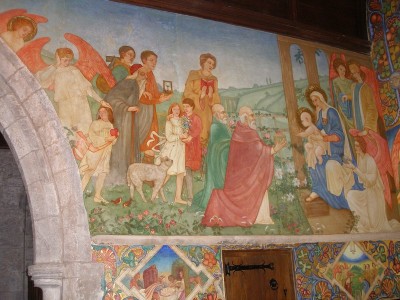
Googling Nottinghamshire for images produces a remarkably poor selection, but I did find that the church of St Peter in the tiny village of Clayworth has a fine set of murals painted right at the very beginning of the 20th century by the Irish-born artist Phoebe Traquair and this week I am posting a picture of the mural on the north wall of the chancel.


Sherwood Forest, Robin Hood and the evil Sheriff of Nottingham. How many men thrilled to those stories as boys? Well, Sherwood Forest exists - at least, in part - even if the outlaw Robin Hood is probably no more than a legend and a large part of Sherwood Forest is in Nottinghamshire.
Although in my younger days I visited and stayed with family friends in the county, I was not then interested particularly in the local scenery. I was, for example, unaware that the largest sun dial in Europe can be found at Sutton-in-Ashfield. (Actually, it wasn't in those days, having been made only in 1998.) I never did happen to be there at the time of the Goose Fair, an annual event first held in Nottingham more than 700 years ago.
Googling Nottinghamshire for images produces a remarkably poor selection, but I did find that the church of St Peter in the tiny village of Clayworth has a fine set of murals painted right at the very beginning of the 20th century by the Irish-born artist Phoebe Traquair and this week I am posting a picture of the mural on the north wall of the chancel.
Friday, 25 March 2011
Back across the pond

I love the architecture in Ribeauville, a small town in Alsace, north-east France.
Subscribe to:
Posts (Atom)