that objects and I have to struggle to keep my mouth shut when I hear:
"hopefully" instead of "I hope";
"was" instead of "were" (you/we was there too);
"can I get" instead of "may I have"
"should of" instead of "should have".
And there are others - but you get the idea!
Friday, 21 July 2017

Tuesday, 18 July 2017
City Daily Photo
Some years ago I discovered the City daily Photo website and wasted spent a considerable amount of time each day visiting cities around the world. I even started my own daily blog with photos I took in and around Brighton.
This had all virtually (pun intended!) slipped from my memory until this morning. I had an outpatient's appointment at the hospital (no real problem, just a follow-up from an earlier consultation and no further action required) and on the way back to the car I walked past St George's church, the parish church for Kemp Town. I had photographed the church back in the 'old days', and here it is:

It doesn't look English to me!
Built in 1824-25, the total cost was £11,000. According to Wiki, "After Revd James Anderson became curate of the church in 1828, his close association with Queen Adelaide, the consort of King William IV, made the church very popular. The queen consort was popular with the British people and often spent time in Brighton. When in the town, she worshipped at St George's." Hence the Royal coat of arms above the door.
This had all virtually (pun intended!) slipped from my memory until this morning. I had an outpatient's appointment at the hospital (no real problem, just a follow-up from an earlier consultation and no further action required) and on the way back to the car I walked past St George's church, the parish church for Kemp Town. I had photographed the church back in the 'old days', and here it is:

It doesn't look English to me!
Built in 1824-25, the total cost was £11,000. According to Wiki, "After Revd James Anderson became curate of the church in 1828, his close association with Queen Adelaide, the consort of King William IV, made the church very popular. The queen consort was popular with the British people and often spent time in Brighton. When in the town, she worshipped at St George's." Hence the Royal coat of arms above the door.
Sunday, 16 July 2017
Inflation?
One of our supermarket chain has been advertising this week:
"British cherries, strawberries, raspberries - £2 each"
And in the pub where Brighton Lions held their dinner meeting this week:
"FREE - function room for hire!"
But maybe it's just me.
"British cherries, strawberries, raspberries - £2 each"
And in the pub where Brighton Lions held their dinner meeting this week:
"FREE - function room for hire!"
But maybe it's just me.
Saturday, 15 July 2017
More about Will
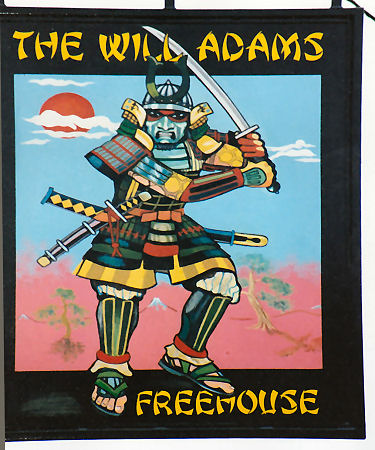
As I inferred in my last post, the people of Gillingham knew nothing about Will Adams - and, for the most part, cared even less! But that we 60 years ago. Now I understand that there is a Will Adams NHS Treatment Centre, a Will Adams ward in the Medway Maritime Hospital, a Will Adams Pupil Referral Unit, a pub named The Will Adams - and even an annual Will Adams Festival! It seems that Gillingham's most famous son is at last becoming famous!
So who was Will Adams?
Will was born in 1564, he was apprenticed to a Limehouse shipyard owner and learned shipbuilding, astronomy and navigation before entering the Royal Navy, where he served under Sir Francis Drake and saw action against the Spanish armada. In 1598 he sailed in a convoy of Dutch ships for the Dutch East Indies via the Magellan Straits, the west coast of South America and Japan. After many disasters, Adams was one of the few men to reach Japan, the first Englishman to have reached that country. He was forbidden to leave Japan, became a samurai and was forced to take Japanese nationality. He died in Japan in 1620.

So who was Will Adams?
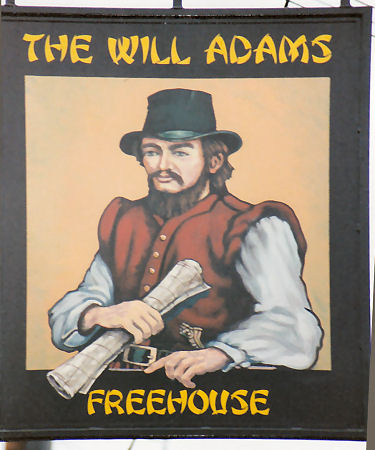 |
| The pub sign. Photo Brian Curtis |
Will was born in 1564, he was apprenticed to a Limehouse shipyard owner and learned shipbuilding, astronomy and navigation before entering the Royal Navy, where he served under Sir Francis Drake and saw action against the Spanish armada. In 1598 he sailed in a convoy of Dutch ships for the Dutch East Indies via the Magellan Straits, the west coast of South America and Japan. After many disasters, Adams was one of the few men to reach Japan, the first Englishman to have reached that country. He was forbidden to leave Japan, became a samurai and was forced to take Japanese nationality. He died in Japan in 1620.
Friday, 14 July 2017
Will Adams
Will Adams is proclaimed as the most famous person to have been born in my home town. not that I, as a boy in Gillingham, ever knew anything about him. Nor, I suspect, did many other residents. All I knew was that there was, standing on the grass verge on the Top Road, a dusky pink clock tower that, as I had been told, was the Will Adams Memorial.
It seems almost incredible now, but when I was about 8 or 9, our entertainment on summer Sunday evenings would be a walk along the Top Road to the Will Adams and back. But the walk was incidental; the real entertainment came from gawking at all the coaches stuck in the traffic jam.
The Top Road - as we called it - was Watling Street, the A2, the main road from London to Dover. Some miles to the east, a side road left Watling Street and headed for the seaside destination of choice for hundreds, maybe even thousands, on people from south London: Margate.
Back in those days, before even television was commonplace, few people possessed cars and a trip to the seaside involved a coach trip. As they headed back to London after a day on the sands, the Londoners (in my mind almost a strange race from a distant galaxy) would find themselves stuck in the traffic as it approached the bottleneck on Chatham. Indeed, many of the coaches would be standing in Chatham already as the boundary between Gillingham and Chatham ran along the centre of the road for some of this way.
We had very simple tastes in those days.
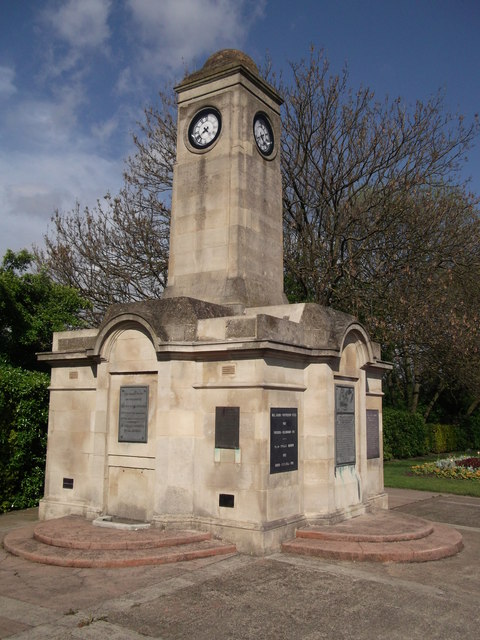 |
| Copied from geograph.org.uk |
The Top Road - as we called it - was Watling Street, the A2, the main road from London to Dover. Some miles to the east, a side road left Watling Street and headed for the seaside destination of choice for hundreds, maybe even thousands, on people from south London: Margate.
Back in those days, before even television was commonplace, few people possessed cars and a trip to the seaside involved a coach trip. As they headed back to London after a day on the sands, the Londoners (in my mind almost a strange race from a distant galaxy) would find themselves stuck in the traffic as it approached the bottleneck on Chatham. Indeed, many of the coaches would be standing in Chatham already as the boundary between Gillingham and Chatham ran along the centre of the road for some of this way.
We had very simple tastes in those days.
Monday, 3 July 2017
Ton up!
My thought processes are always meandering, frequently meandering in ever increasing circles until I have absolutely no idea how I end up where i do, nor even where I started! but this time I can actually follow the convoluted trail from the beaches of Dunkirk (or Dunkerque, as the French would have it.) to the city of Chicago.
(As a diversion, many people are unaware that Dunkirk is in England. It is a village in Kent, not far from Canterbury!)
I mentioned the Dunkirk evacuation yesterday in connection with the paddle steamer, the Medway Queen. It was, of course, immediately after that defeat-seen-as-victory that Churchill made what is possibly his most famous speech:
What I have only today discovered is that, although the speech was made in the House of Commons in 1940, Churchill only recorded it in 1949! You can read about it here. But I digress again.
It was only a matter of three or four months after Churchill gave that speech that the Blitz began. Much of London, especially the docks and the East End, was flattened. When men of the Canadian air force saw the conditions in which people were living, and especially the lack of food, they wrote home. Lions Clubs in Canada responded by sending food parcels.
After the war, the Queen (later Queen Elizabeth the Queen Mother), who had been very much impressed by this generosity, sent an equerry to Canada to find out about Lions Clubs. As a result, Canadian Lions established Lions Clubs in England. Indeed, it was a Canadian who was responsible for establishing Brighton Lions Club. A short quote from Diamond Geezers, the history of the first 60 years of Brighton Lions Club:
Oh dear, I'm wandering again! But we now have a mention of Chicago. That is where the first Lions Club was formed back in 1917, and that is where this year's international convention is being held right now.
(As a diversion, many people are unaware that Dunkirk is in England. It is a village in Kent, not far from Canterbury!)
I mentioned the Dunkirk evacuation yesterday in connection with the paddle steamer, the Medway Queen. It was, of course, immediately after that defeat-seen-as-victory that Churchill made what is possibly his most famous speech:
What I have only today discovered is that, although the speech was made in the House of Commons in 1940, Churchill only recorded it in 1949! You can read about it here. But I digress again.
It was only a matter of three or four months after Churchill gave that speech that the Blitz began. Much of London, especially the docks and the East End, was flattened. When men of the Canadian air force saw the conditions in which people were living, and especially the lack of food, they wrote home. Lions Clubs in Canada responded by sending food parcels.
After the war, the Queen (later Queen Elizabeth the Queen Mother), who had been very much impressed by this generosity, sent an equerry to Canada to find out about Lions Clubs. As a result, Canadian Lions established Lions Clubs in England. Indeed, it was a Canadian who was responsible for establishing Brighton Lions Club. A short quote from Diamond Geezers, the history of the first 60 years of Brighton Lions Club:
Why Brighton was selected as the place in which to form a new Lions Club is not known, but some years later Dennis Venning, one of the charter members, was to recall how it came about:
A representative of Lions International headquarters in Chicago, a Canadian named Murray Huggan, came to Brighton in the late summer of 1950 following the successful formation of a Lions Club in London. He had been advised to get in touch with Dick Pockett, and Dick, who was a great pal of mine, got in touch with me and we decided to meet up with this Murray Huggan and see what it was all about. We got hold of four other persons who I thought might be interested and we had a meeting in the Old Ship Hotel to hear all about it. We were all a bit dubious at first and I remember that one thing we asked for was a copy of the latest annual accounts of the Association; our friend had not got such accounts available and so he had to send to Chicago for them. Anyhow, they arrived pretty quickly and we were quickly satisfied as to the credentials of the International Association of Lions Clubs.
Sunday, 2 July 2017
Medway Queen
I don't really remember my paternal grandfather. he died when I was 9 years old, having lived in the house next door all my life, so I find that lack of memory rather surprising. My brother - two years younger than me - does remember him, so why can't I? What i do remember is that he took both of us boys to the cattle market in Chatham on more than one occasion. Having said that, all I can remember of those trips is the squealing of the pigs as they had tags inserted in their ears!
I also have a memory - although I still can't picture Granddad in it- of him taking me on a trip aboard the Medway Queen. The Medway Queen was a paddle steamer that ran from Sun Pier, Chatham, to Southend.

Built in about 1924, she served as a minesweeper during World War II but her real moment of glory was in 1940 when she made seven trips to the Dunkirk beaches, rescuing about 7,000 men and shooting down three German aircraft. returned to civilian use after the war, she was taken out of service in 1963 before being used as a night club on the Isle of Wight. She was eventually restored (rebuilt?) and is now back on the River Medway, moored at Gillingham Pier.
All this was brought to mind as I see there is a programme about the Dunkirk evacuation on television tonight.
I also have a memory - although I still can't picture Granddad in it- of him taking me on a trip aboard the Medway Queen. The Medway Queen was a paddle steamer that ran from Sun Pier, Chatham, to Southend.

Built in about 1924, she served as a minesweeper during World War II but her real moment of glory was in 1940 when she made seven trips to the Dunkirk beaches, rescuing about 7,000 men and shooting down three German aircraft. returned to civilian use after the war, she was taken out of service in 1963 before being used as a night club on the Isle of Wight. She was eventually restored (rebuilt?) and is now back on the River Medway, moored at Gillingham Pier.
All this was brought to mind as I see there is a programme about the Dunkirk evacuation on television tonight.
Subscribe to:
Posts (Atom)