Saturday, 30 April 2011

Scenic Saturday - Merseyside

Number 39 in the series.


This is one of the newer counties carved out of Lancashire and Cheshire and centred on the city of Liverpool. It covers part of the Wirral peninsula with the once-great shipyards of Birkenhead (previously Cheshire) and stretches up the (Lancashire) coast to reach beyond Southport. The county is split in two by the River Mersey under which there is a tunnel and on which there are ferries between Liverpool and Birkenhead. Lying between Liverpool and Southport is Formby with its sandy beach backed by dunes and woodland. The beach and dunes feature in this picture by Peter Heyes.

Friday, 29 April 2011

It's a funny old day

Today is neither fish nor fowl: it's a public holiday but not a statutory one. That means that some businesses are working as usual, some are asking some staff to work but for no extra pay although they will get a day off in lieu, some workers will be offered overtime and a day off in lieu and some businesses are closed for the day. Certainly the streets were quieter than usual when I took Fern for her walk this morning so I guess that means most people have the day off to watch the wedding.

What wedding, you ask? The wedding of Prince William and Kate (or Catherine as we should call her now) Middleton. The papers have been desperate to fid something new to say about the occasion over the last couple of days and have been reduced to reporting numbers and betting odds. I have seen figures ranging from 8,500 to 12,000 for the number of media people in London and I forget how many miles of cabling, how many portaloos etc. The estimate is that about a million will be lining the procession route, some having been camped on the pavement since Monday and some having travelled in from the USA, Canada and even a whole family from Australia. The worldwide TV audience is expected to be 2 billion.

I do, of course, wish William and Kate every happiness. But I'm also pleased that we will have a worldwide audience for something we Brits can still do fairly well. Every wedding is theatre, but this one will be theatre on a truly grand scale. I don't think I am verstating the case when I say that there are few countries which can manage that as well as we can. I'm quite looking forward to watching.

Thursday, 28 April 2011

What I should be doing

The grass needs cutting, I still haven't finished writing the minutes of last week's Lions meeting, I should have Jungle Jottings done by now, part of the vegetable patch still needs weeding, the runner bean seeds need to be sown, the car is filthy inside and out... All things I should be doing but I can't seem to summon up the energy or willpower to do any of them right now. It doesn't help that there is a stiff, cold, north-easterly wind blowing. To think that last Thursday I was in a short-sleeved shirt and wishing I had worn shorts. Today when I took the dog out I was wearing a shirt, sweatshirt and fleece and I wasn't over-warm by any means. In fact, by the time we got home my hands were quite cold.

Wednesday, 27 April 2011

Back home

What a splendid weekend of weather it was with wall-to-wall sunshine pretty well all the daylight hours. I had expected to be working for some of the time as I had been warned that the new fruit trees planted in the Pond Field had to have protection from the cattle. This would have involved constructing a fence around each tree - all 18 of them so far - but the ground is so hard that it would have been almost an impossible task to knock the posts in. So we left it for another time when rain has softened the earth.

On two evenings my cousin-in-law and I went on bat hunts. C-i-l is very interested in ecology and there is a roost of the rare greater horseshoe bat in nearby Brockley Hall. These creatures apparently follow well-defined routes when they leave the roost at dusk and their route takes them down the garden. Armed with a bat detector - a machine that converts the high-pitched "sounds" the bats emit when hunting - a bit like radar - into something that can be heard by the human ear. We weren't too successful on the first occasion as we had left it a little late, but on the second evening we saw and heard a good number.

It was quite an international weekend as well. I was walking a couple of the dogs (at that time there were four springer spaniels in residence) across one of the fields when I met c-i-l's elder brother who lives nearby. He had with him not only his wife, who is Dutch, but their four guests - two Dutch and two American. Then on Monday two other friends of the cousin and her husband arrived - one French and one Spanish. Quite an international gathering for a quiet corner of deepest Somerset.

I took a few pictures which I will post on Fern's blog.

We got home yesterday in the late afternoon to be greeted by our blackbird singing lustily from the sycamore (and he's back again this morning). But perhaps he has been singing all weekend and he wasn't really greeting us. Funny how, no matter how comfortable the beds when one is away, it's always good to get back to one's own bed.

Saturday, 23 April 2011

Scenic Saturday - Greater Manchester

Number 38 in the series.


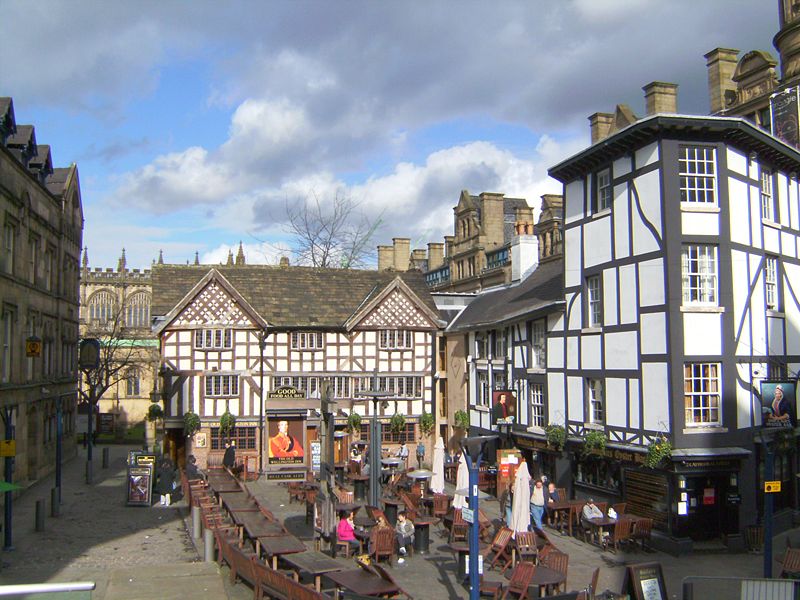
This "county" covers the city of Manchester and towns around such as Stockport, Tameside, Trafford, Bolton, Bury, Oldham, Rochdale and Wigan. Although there is some countryside - park of the Pennine chain - in the east, the county is predominately urban. Indeed, Manchester is the second most populous are in England. This was cotton country, the raw material being shipped in either through the docks at Liverpool or, probably more frequently, direct to Manchester via the 36-mile-long Manchester Ship Canal.

This week's picture is of Shambles Square, Manchester.

Wednesday, 20 April 2011

Down on the farm

With Easter coming this weekend there is only one place for the Old Bat and me to be. For more than 25 years it has been our custom to visit my cousin and her husband on their farm a few miles outside Bristol. (I wonder why there is no generally accepted term for the spouse of a cousin? I can't keep referring to "my cousin's husband" so without further ado I shall coin the phrase "cousin-in-law".)

Although I am no farmer, being a thoroughbred townie, I have, over the years, turned my hand to numerous jobs around the farm, albeit frequently acting mainly as gofer to my c-i-l. I have helped to dig holes for fence posts. That, on the face of it, sounds an unnecessary task but these fence posts were not the usual chestnut stakes. They were mini telegraph poles almost a foot in diameter and needed to be buried four feet into the ground. I am talking about the corner posts for an 8' high fence of high tensile steel netting to contain deer. At that time, there was no money to hire a contractor to do the job so it had to be done by hand. I have repaired the ordinary sort of barbed wire fence, having herded the cows that had broken it down back from the garden which contained grass so much more luscious than they had in the field. I have rounded up sheep, ducks and geese, though not all at the same time. Using my minimal carpentry skills I have constructed gates, I built a pig pen and dug a trench across the rock-hard ground of the yard. I helped install a milking machine and taught calves to drink from buckets. I have cut down trees (and tended the resulting bonfires) and I have planted hedges.

My job this year, I am told, is to construct cow-proof protectors for the fruit trees c-i-l wants to plant in groups in the Pond Field.

The weather forecast is good - at the moment - so it should be an enjoyable weekend with fresh air, good food, good wine and good company. Oh, and I'm meeting that long-lost cousin again for lunch on the way to the farm.

See you next week.

Tuesday, 19 April 2011

I blame the bank

It seems to be the fashion since the world was overtaken by an economic crisis for the banks to be blamed for the crisis and all the other ills of mankind. I have so far managed to resist taking part in the bank bashing because, whilst I agree they made mistakes, those mistakes would not have happened if there had not been greedy people prepared to take advantage of them and, indeed, positively to encourage bankers in their folly. But today it is my turn to join the lynch mob.

While I was at school I probably smoked the very occasional cigarette - when there is a group of six-formers on the beach with one or two smokers among them, it seems natural. But I wasn't really a smoker then although I have been a smoker now for round about 50 years. It is all the fault of the banks. Well, not so much banks (plural) as one bank in particular: the bank that employed me. I left school at the age of 18 without any real idea of how I would earn a living. My intention had been to attend university and, during my time there, think about my options. However, my exam results were not of the high standard required by any university of my choice and I was brought down to earth with a bit of a jolt. It was all very well stacking supermarket shelves to earn pocket money, but that wasn't going to bring me the standard of living I hoped to enjoy. I needed to look elsewhere and banking seemed a reasonable choice.

The bank I selected for the honour of employing me was doubtful. The local staff manager had no doubts about the bank's suitability to be honoured in such a way: his doubt was about me. My health record was not good and he was a little dubious about my ability to withstand the rigours of staying on my feet all day at a till, there being no thought in those days of sitting while serving a customer. Wisdom eventually prevailed and I duly reported to one of the Brighton branches to be inducted into the secrets of the financial world. It goes without saying that my working day was taken up entirely with such exciting activities as applying a rubber stamp to several thousand pieces of paper, filing, sticking stamps on envelopes and other similar activities dangerous to my health.

I had not been employed for a year before I was informed that I had been selected to attend a course, an Outward Bound course at a centre in the Lake District. This course, I was told, involved team-building exercises and would fit me for future leadership. So, in the late autumn of that year, I caught a train to Penrith for a month in the mountain air of Cumbria. During the course there would be no alcohol and no tobacco. And the tea contained bromide. In any case, it was an all-male affair.

Much of the first week was spent in the classroom learning first aid and map-reading with a daily work-out on circuit training - press-ups, pull-ups and all sorts of other torture. We students gazed longingly at the hills, wishing we could be up there with the circuit training nothing but a bad memory. We were allowed one luxury. It was considered too cold for us to take a 6.00am dip in the lake and we took cold showers instead.

It was the second week before all the classroom instruction was to be put into practice, at first in large groups led by an instructor. We hiked the hills, bivouacking overnight, we canoed, we scaled rock faces and abseiled down again. It was a sort of junior commando training. All this was in preparation for the final hike when we would spend three days on the fells in groups of four.

I can't remember the exact make-up of my group for that last exercise but I do recall that one of the group was a police cadet from Rugby. We seemed to team up naturally and he and I spent the nights in a small two-man tent. I can't remember his name. It wasn't Tom, but for the sake of ease I will call him that.

Mid-afternoon on the third day of the hike: darkness falling and the fog so think we could hardly see our feet. We were walking downhill towards a flattish spot beside a tarn that we had identified on the map. We knew we were walking in the right direction as we could hear the stream feeding the tarn bubbling along on our left. (When the fog lifted slightly we saw that if we had taken just one step to the left we would have been in the stream.) Reaching the selected camp site we wasted no time erecting the tents, changing out of our wet clothes and diving into sleeping bags before lighting the primus stove to cook our meal. With the stove and dirty utensils put outside the tent until morning, sleep came easily.

We woke in the early hours to find that the tarn had overflowed and the tent was full of water. Our sleeping bags - and the dry clothes we had put on - we sodden. There was no chance of further sleep. As we lay there, I fantasised. "What wouldn't I give," I declared, "for a rum and coke".

"And a cigarette," replied Tom.

Two days later we left the centre for home. The first thing Tom and I did was to visit a near-by tobacconist's shop and I have smoked ever since.