Saturday, 23 April 2011

Scenic Saturday - Greater Manchester

Number 38 in the series.


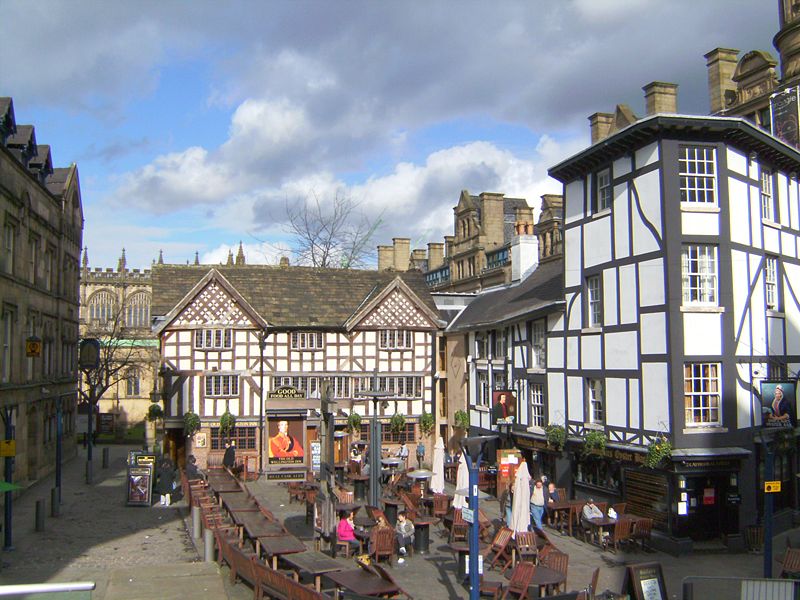
This "county" covers the city of Manchester and towns around such as Stockport, Tameside, Trafford, Bolton, Bury, Oldham, Rochdale and Wigan. Although there is some countryside - park of the Pennine chain - in the east, the county is predominately urban. Indeed, Manchester is the second most populous are in England. This was cotton country, the raw material being shipped in either through the docks at Liverpool or, probably more frequently, direct to Manchester via the 36-mile-long Manchester Ship Canal.

This week's picture is of Shambles Square, Manchester.

Wednesday, 20 April 2011

Down on the farm

With Easter coming this weekend there is only one place for the Old Bat and me to be. For more than 25 years it has been our custom to visit my cousin and her husband on their farm a few miles outside Bristol. (I wonder why there is no generally accepted term for the spouse of a cousin? I can't keep referring to "my cousin's husband" so without further ado I shall coin the phrase "cousin-in-law".)

Although I am no farmer, being a thoroughbred townie, I have, over the years, turned my hand to numerous jobs around the farm, albeit frequently acting mainly as gofer to my c-i-l. I have helped to dig holes for fence posts. That, on the face of it, sounds an unnecessary task but these fence posts were not the usual chestnut stakes. They were mini telegraph poles almost a foot in diameter and needed to be buried four feet into the ground. I am talking about the corner posts for an 8' high fence of high tensile steel netting to contain deer. At that time, there was no money to hire a contractor to do the job so it had to be done by hand. I have repaired the ordinary sort of barbed wire fence, having herded the cows that had broken it down back from the garden which contained grass so much more luscious than they had in the field. I have rounded up sheep, ducks and geese, though not all at the same time. Using my minimal carpentry skills I have constructed gates, I built a pig pen and dug a trench across the rock-hard ground of the yard. I helped install a milking machine and taught calves to drink from buckets. I have cut down trees (and tended the resulting bonfires) and I have planted hedges.

My job this year, I am told, is to construct cow-proof protectors for the fruit trees c-i-l wants to plant in groups in the Pond Field.

The weather forecast is good - at the moment - so it should be an enjoyable weekend with fresh air, good food, good wine and good company. Oh, and I'm meeting that long-lost cousin again for lunch on the way to the farm.

See you next week.

Tuesday, 19 April 2011

I blame the bank

It seems to be the fashion since the world was overtaken by an economic crisis for the banks to be blamed for the crisis and all the other ills of mankind. I have so far managed to resist taking part in the bank bashing because, whilst I agree they made mistakes, those mistakes would not have happened if there had not been greedy people prepared to take advantage of them and, indeed, positively to encourage bankers in their folly. But today it is my turn to join the lynch mob.

While I was at school I probably smoked the very occasional cigarette - when there is a group of six-formers on the beach with one or two smokers among them, it seems natural. But I wasn't really a smoker then although I have been a smoker now for round about 50 years. It is all the fault of the banks. Well, not so much banks (plural) as one bank in particular: the bank that employed me. I left school at the age of 18 without any real idea of how I would earn a living. My intention had been to attend university and, during my time there, think about my options. However, my exam results were not of the high standard required by any university of my choice and I was brought down to earth with a bit of a jolt. It was all very well stacking supermarket shelves to earn pocket money, but that wasn't going to bring me the standard of living I hoped to enjoy. I needed to look elsewhere and banking seemed a reasonable choice.

The bank I selected for the honour of employing me was doubtful. The local staff manager had no doubts about the bank's suitability to be honoured in such a way: his doubt was about me. My health record was not good and he was a little dubious about my ability to withstand the rigours of staying on my feet all day at a till, there being no thought in those days of sitting while serving a customer. Wisdom eventually prevailed and I duly reported to one of the Brighton branches to be inducted into the secrets of the financial world. It goes without saying that my working day was taken up entirely with such exciting activities as applying a rubber stamp to several thousand pieces of paper, filing, sticking stamps on envelopes and other similar activities dangerous to my health.

I had not been employed for a year before I was informed that I had been selected to attend a course, an Outward Bound course at a centre in the Lake District. This course, I was told, involved team-building exercises and would fit me for future leadership. So, in the late autumn of that year, I caught a train to Penrith for a month in the mountain air of Cumbria. During the course there would be no alcohol and no tobacco. And the tea contained bromide. In any case, it was an all-male affair.

Much of the first week was spent in the classroom learning first aid and map-reading with a daily work-out on circuit training - press-ups, pull-ups and all sorts of other torture. We students gazed longingly at the hills, wishing we could be up there with the circuit training nothing but a bad memory. We were allowed one luxury. It was considered too cold for us to take a 6.00am dip in the lake and we took cold showers instead.

It was the second week before all the classroom instruction was to be put into practice, at first in large groups led by an instructor. We hiked the hills, bivouacking overnight, we canoed, we scaled rock faces and abseiled down again. It was a sort of junior commando training. All this was in preparation for the final hike when we would spend three days on the fells in groups of four.

I can't remember the exact make-up of my group for that last exercise but I do recall that one of the group was a police cadet from Rugby. We seemed to team up naturally and he and I spent the nights in a small two-man tent. I can't remember his name. It wasn't Tom, but for the sake of ease I will call him that.

Mid-afternoon on the third day of the hike: darkness falling and the fog so think we could hardly see our feet. We were walking downhill towards a flattish spot beside a tarn that we had identified on the map. We knew we were walking in the right direction as we could hear the stream feeding the tarn bubbling along on our left. (When the fog lifted slightly we saw that if we had taken just one step to the left we would have been in the stream.) Reaching the selected camp site we wasted no time erecting the tents, changing out of our wet clothes and diving into sleeping bags before lighting the primus stove to cook our meal. With the stove and dirty utensils put outside the tent until morning, sleep came easily.

We woke in the early hours to find that the tarn had overflowed and the tent was full of water. Our sleeping bags - and the dry clothes we had put on - we sodden. There was no chance of further sleep. As we lay there, I fantasised. "What wouldn't I give," I declared, "for a rum and coke".

"And a cigarette," replied Tom.

Two days later we left the centre for home. The first thing Tom and I did was to visit a near-by tobacconist's shop and I have smoked ever since.

Monday, 18 April 2011

One of those days

Most days I sit at the keyboard and know just what I intend to write about. That's not to say I actually do end up writing about what I had intended as my subject: my grasshopper mind frequently takes me in a completely different direction and what ends up on the blog bears no resemblance to what I had meant to write. I understand some authors of fiction find this happens with their books. There are those authors, or so I understand, who plan their novels scene by scene and know exactly what is going to happen before they write even the opening sentence. Other authors start off with an idea of the plot but find the characters they have invented take control of the story which then just writes itself. Don't misunderstand me: I'm not putting myself in the same class as many published authors, although there are some whose books are so dire that I consider myself in a class above them. Why their publishers think the books will sell is completely beyond me.

See? It's happened again. I started out with absolutely no intention of slagging off writers or publishers.

Well, our resident blackbird has been perched high in the sycamore singing lustily for most of the weekend. When he takes a break to nip off for a juicy worm steak or snail fritter or whatever the garden seems almost eerily silent. I was in the vegetable garden yesterday afternoon and enjoyed a pleasant serenade as I sowed the parsnip seeds. Fern, our springer spaniel, enjoys gardening and delights in accompanying the Old Bat or me when we are working out there. She especially enjoys weeding, sticking her nose in to see what is being pulled out and generally making a nuisance of herself. Many years ago I constructed a picket fence across the garden to keep dogs off the vegetable plot. When I am down there digging or whatever, Fern lies as close as she can get to the fence, much of the time at the gate with her nose poked underneath as far as it will go.

I built an archway over the gate which we call a pergola although it isn't really large enough to merit the description. Now I always though the word 'pergola' should be pronounced with the stress on the second syllable but I looked it up in the dictionary yesterday and found I have been wrong all these years: the stress is on the first syllable. That pergola is covered by a clematis, another word I was unsure about pronouncing. I have always said 'clem-eight-iss' with the stress on the second syllable (again) but I have heard it said 'clem-at-iss' with the first syllable stressed. I find that both are correct. As somebody remarked on another blog the other day, English is an odd language.

I seem to have meandered through several subjects today so I will finish now before I get myself in too much of a tangle and you, dear reader, hopelessly confused.

Sunday, 17 April 2011

Wedding fever


I have so far managed to avoid any mention of the forthcoming Royal Nuptials, not because I am anti-monarchy (or anti-marriage), nor because I am completely without interest in the matter. I think that in our soon-to-be Princess Kate, or Catherine as we must learn to call her, we have a very attractive woman whose picture I am happy to see in the newspaper. She seems always to be wearing a dazzling smile which lights up the gloomiest morning.

The press have used not just column inches but yards covering just about every aspect of the wedding day from speculation about the designer of the wedding dress to advice on her hair style and make-up. Funny how it has all been directed at Kate with William being completely swept aside as if he has just a walk-on part in the whole thing.

There has been - shall I say, encouragement? - from No 10 for street parties to be held on 29 April (the wedding day) and local councils have been told to cut out the red tape involved in giving permission for these. Despite this, there have been reports of bureaucratic nightmares for some people and, in any case, the number pf these parties being planned is fairly small. I suppose this is partly because the weather in this country is iffy at any time and particularly so in April and partly because we just don't "do" street parties anymore in the way that we did say, 60 or 70 years ago.

Street parties or not, the forecast is for a worldwide television audience of billions. I just hope she knows what she is letting herself in for.

Saturday, 16 April 2011

Scenic Saturday - West Yorkshire

Number 37 in the series.


West Yorkshire is wool country. With sheep grazed on the higher moors and plentiful water running through the valleys - the famous Yorkshire dales - towns such as Leeds, Halifax and Huddersfield grew prosperous on the wool industry. There are literary connections as well: this is Brontë country and the village of Haworth attracts many admirers of their work. More recently, a long-running television comedy, Last of the Summer Wine, was filmed in and around Holmfirth.

The Pennines run down the western side of the county and this week's picture shows the dry stone walls that are typical of the area.

Friday, 15 April 2011

Four and twenty blackbirds

Some few days back I commented on the hen blackbird I had been watching as she gathered material for her nest before disappearing into a neighbour's fir tree. I haven't seen her for several days so I don't know if she has finished the nest and is sitting on eggs or if she has abandoned that site and started afresh somewhere else. The cock blackbird, however, is very much in evidence. He spends a lot of time high in the sycamore tree in another neighbour's garden, singing his heart out. I noticed yesterday evening that he had started quite a while before dusk and was still going strong an hour later. I took a camera down the garden in the hope of taking a movie of the apple blossom buds while capturing his song as a sort of background music. He immediately moved to a tree farther away but was still loud enough to record. However, when I came to play back the movie there was no sound. Maybe that camera doesn't record - I'll have to try with a different one, perhaps this evening.

This morning something woke me just after 5.00. What it was I couldn't say and it wasn't long before I dropped off again. But not before I had noticed the blackbird was singing again in the sycamore. When I woke again soon after 7.00 he was still at it. He didn't stop until just after 9.00 but was back on song again by 10.00.

I love listening to the song of the blackbird. It always reminds me of two things: walking to Scouts as a teenager when, at this time of the year, there was always the song of the blackbird to accompany me down the road; and the trilogy by John Masters, Loss of Eden (Now, God be Thanked; Heart of War and By the Green of the Spring). Set in Kent and the western front during the First World War, these books bring home the futility of war and, at the same time, how war can bring out the best in some people. And the connection with blackbirds? One of the principal characters is executed for cowardice (he was suffering from shell shock) and as he is led out to his death he hears a blackbird singing.

The blackbird is one of the "finalists" in the Battle of the Birdsong being run by the National Trust. Five species have been selected by naturalists and the public are asked to vote for their favourite. The five species are blackbird, robin, song thrush, blackcap and swift. (See more and listen to the different songs right here.) I'm not sure that their recording of a blackbird is the best: ours certainly sings better than that. What surprises me is that the skylark is not one of the selected species. As things stand I shall have to vote for the blackbird, but if the skylark were there I would find it difficult to choose between them.

(I've just had another look at that web site and I can vote for the skylark. Oh dear, what a decision.)

The song of the skylark can be downloaded here. This, to me, is the sound of the South Downs.