Monday, 7 September 2015

Vague thinkings

Well, it is Monday and even though I am long since retired, I still tend to view Monday mornings with a slight sinking feeling.  Completely irrational, I know, but there it is.

So, what, you ask (or maybe not), are these vague thinkings?
  • I do hope that nothing horrific happens between now and Wednesday afternoon.  I think it will be sometime in the afternoon on Wednesday that the Queen becomes the longest reigning monarch this country has ever had.  The newspapers over the weekend covered the anticipated event but the colour supplements yesterday were almost devoted to it.
  • The funeral of my friend went off on Friday almost without a hitch.  There were so many people there that the crematorium rigged up a loudspeaker system outside the chapel but the funeral directors managed to cram everybody inside, standing in every space available.  I had agreed to make a tribute and had laboured long over what I would say.  What I had not planned for was that two of his sons would speak before me and between them they covered quite a lot of what I had planned to say.  My tribute had to be made very much off the cuff.
  • Unfortunately, the Old Bat had been unable to accompany me.  We had been out for a meal on Thursday evening and just as we were leaving, she fainted.  Everyone was very kind and attentive but she recovered after a few minutes and felt much better once outside in the fresh air: it had been hot in the restaurant full to overflowing.  But next morning she felt unwell, so unwell that I had to cancel an appointment she had with the oncologist that morning.  The doctor, however, telephoned while I was out and told her that things were looking good although she would like another blood test next week just to be on the safe side.  I was much relieved as it was this time last year that almost the same thing had happened and that was when the Old Bat had to be admitted to hospital as an emergency, only to be told she had cancer.  Thank goodness she was back to normal on Saturday.
  • That picture of Watendlath Tarn yesterday reminded me of another lake picture.  This is Siesta Lake in Yosemite National Park.  It seems hardly possible that it is now very nearly nine years ago that i took this picture.


Sunday, 6 September 2015

Watendlath - a last look

I last visited Watendlath seven years ago this month.  The old Bat and I, my brother and his wife had rented a cottage near Grasmere.  Getting to the cottage from the village was almost as tricky as getting to Watendlath.  First there was a narrow lane to negotiate  with two gates into and out of fields to be closed before we reached a farmyard.  In the yard, we turned sharp left and descended to cross a narrow bridge before heading off-track across two more fields - with their attendant gates, cows and sheep.

Our home for a week.

While we were there - in the Lake District - we visited Dove Cottage (Wordsworth's home) and Hill Top (Beatrix Potter's home) as well as some of the most scenic parts.

Mr MacGregor's garden at Hill Top
Dove Cottage


And, of course, we went to Watendlath.  There had been changes since I took the Scouts there for tea.  Now there was a pay and display car park, courtesy of the National Trust who own the land, and the tenant farmer had added a bit onto the farmhouse to use as a cafe with picnic tables on the terrace outside.  But despite these changes, which were really no more than superficial, the place still exuded a feeling of peace.

Watendlath Tarn

I'd like to think I might go back again some day but, in all honesty, that does seem a bit unlikely.  In any case, maybe it would be better for me to remember the hamlet as it was rather than see what other changes might have spoiled it for me.

Saturday, 5 September 2015

Scouting out Watendlath

While on that last visit to the hamlet when the Old Bat and I stayed at the farm, we sought out a suitable camp site.  I was then running a Scout troop and the plan was to camp that summer in the Lake District.  Although I was the only leader at the time, my brother had volunteered his services.  between us we would drive a minibus (for the scouts) and a van (for the gear) from the Sussex coast to the Lake District.  My brother was working in Coventry, about half way between the start and the destination, and he arranged that we could bed down on the floor of a Scout hut in the city to break the journey.

Anyway, the Old Bat and I found a suitable spot for the camp.  It was in a field strewn with lumps of granite so we would have to pitch the tents in free spaces, and there was a stream running through the middle of the field.  Quite a fast-running stream, I might add.  This provided great amusement to the Scouts, who organised races between metal plates rather along the lines of Pooh sticks.  I wish I could remember just where that camp site was.
Click to enlarge

Much of the week was spent hiking on the fells.  I remember one particular hike quite well.  We had driven to the head of Borrowdale, to a spot where the valley forked into two.  From there we would head up to Styhead Pass, then round past Sprinkling Tarn to meet Grains Gill and follow the stream back off the fells.  When we were part way round - we had past Sprinkling Tarn and were approaching Grains Gill - the mist descended as it does sometimes in that part of the world.  We were well prepared with maps and compasses and we had suitable footwear, unlike so many others on the hills that day.  We heard one man, wearing sandals, complain about the lack of signposts!  As we descended the gill, we noticed that another group, unsuitably clad and probably lacking the basics such as a map, had tagged on behind.  It seemed obvious to us that they were expecting - hoping! - that we would lead them to safety.

Then one afternoon we hiked over the fells to Watendlath.  I had arranged with Mrs Tyson at the farm that she would provide tea for us, including Cumberland rum butter: "a lightly spiced butter, laced with dark rum - this traditional old recipe originates from the county of Cumberland in the Lake District of Northern England. In Cumberland, rum butter served with oatcakes or buttermilk scones were given to friends who called at the house to see a new baby. In turn they would leave a silver coin, and on the day of the christening, when the butter bowl was empty, the coins were placed in it. A sticky bowl, with plenty of coins sticking to it, meant that the child would never be wanting. The saying goes...... “Butter symbolizes the richness of life, sugar the sweetness of life and rum, the spirit of life.”"

Watendlath Farm in 2007

Friday, 4 September 2015

Return to Watendlath

Less then two years after my first, mesmerising visit to the hamlet of Watendlath, I was back.  The Old Bat and I stayed in a small hotel in Keswick - in separate rooms, I might add, as we were not then married and I had promised her mother.

Strange to tell - well, it seems strange to me - I have no recollection of that visit to the hidden valley.  I do very well recall that we climbed a hill on the opposite side of Derwentwater, Catbells.

Walkers follow the path to the summit of Catbells fell looking over Derwentwater towards Keswick and Skiddaw
Anna Gowthorpe/PA

In our youth (as we were then) this seemed a gentle stroll. The main problem was the sheep that seemed intent on eating the Old Bat's bar of chocolate!

(Not a good picture but one I scanned from an old 35mm slide.)

Actually, this is possibly the most popular walk in the Lake District and Catbells is not exactly a mountain, being only 1,480 feet high.

According to the Wiki, "The fell's unusual name may well have come from a distortion of 'Cat Bields' meaning shelter of the wild cat, although this is not certain. The fell's name is sometimes written as Cat Bells and is so printed on some maps."

Some time after that visit I came across the four books by Hugh Walpole,  The Herries Chronicle.  Watendlath featured in the books and it was as a result of this that on our next visit to the Lakes we stayed at Watendlath Farm where the farmer's wife, Mrs Tyson, provided bed, breakfast and evening meal.

We would be out all day, but always had to allow at least half an hour to drive along the narrow approach road.  This is only about three miles but is a narrow road with passing places - and it seemed that we were for ever having to back to allow another car past.  The road runs over Ashness Bridge, from where one of the best known views in the Lake District is so often photographed.


Going on, one arrives at Surprise View, from where one looks roughly north across Derwentwater and south west into Borrowdale.


Thursday, 3 September 2015

In which we reach Watendlath

To get back to what I really should have posted yesterday - before I digressed, which is something I seem to do more and more easily as I drift silently - well, almost silently - into senility . . .

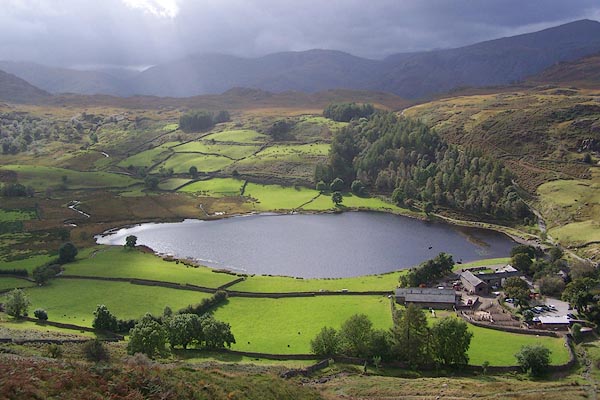
The secret village of Watendlath - which, if you paid attention yesterday, you will remember is neither secret not a village - lies at the end of a valley south of Keswick.  There is a road, but I came to the hamlet - just a farm and a couple of cottages back in 1961 - from the east, over the fells (which is what they call the hills in Cumbria).  I don't recall how many there were of us in the party but I do know we were accompanied by an instructor from the outward Bound centre on the shore off Ullswater.  We had come over Helvellyn, round Thirlmere and dropped down into Watendlath en route for Borrowdale.  This was in November so the view of the hamlet I had as we descended the fellside would have been rather less lush than in the picture below

I think the photo is probably ©  Martin and Jean Norgate: 2014, Portsmouth University

Even at the tender age of 19, I was much impressed by the beauty of the place.

We crossed the packhorse bridge and made our way up the track leading behind the trees in the right in the photo above.  I do remember that for part of the way we were accompanied by, or maybe we accompanied them, a woman with her two teenage daughters.  We had been without feminine company for at least two weeks by then, so despite the bromide with which our tea was habitually laced at the centre, we passed a pleasant half hour or so.

Photo: Grevel Lindop

Wednesday, 2 September 2015

Watendlath

For some reason completely obscure, the thought of secret places came into my mind.  To be a little more precise, secret villages.  That led me to remember Watendlath, although - truth to tell - Watendlath is neither secret nor is it a village.  It is just a hamlet, situated in the English Lake district a few miles south of Keswick.

I'm not sure why the area is called the Lake District.  No, that's not true: I do know why it is called the Lake District.  It is because there are quite a lot of lakes in the area, although they are not actually called lakes.  They are known as waters, such as Ullswater, Derwentwater and Coniston Water, or meres, like Windermere and Thirlmere, or thwaites, like Bassenthwaite.  Most are natural but there are at least two - Thirlmere and Hawes Water - that are man-made reservoirs made to supply water to Manchester.

But I digress.

I discovered Watendlath in October or November 1961.  Again, that's not exactly true.  I didn't discover Watendlath, I was led to the hamlet.  The bank by which I was employed supported the Outward Bound schools and regularly sent a handful of young employees on their courses.  I have no idea how or why I was picked out to attend but I duly set off on the train to Penrith where I and a handful of other young men were collected and driven to the Outward Bound centre on the shore of Ullswater.  The next month would involve no smoking, no alcohol, and bromide in the tea.  The first week consisted of cold showers first thing in the morning as it was considered too cold for us to take a dip in the lake, classroom lessons in knotting, first aid and - most importantly - map reading.  My experience in the Scouts meant that I already knew much of this and was soon dragooned into acting as an extra (unpaid) instructor.  Also on the schedule was circuit training on an outdoor course: press ups, pull ups, sit ups, and all sorts of other horrors were involved.  We gazed at the purple hills on the other side of the lake and wished with all our hearts that we could stride along the ridge rather than suffer another pull up.

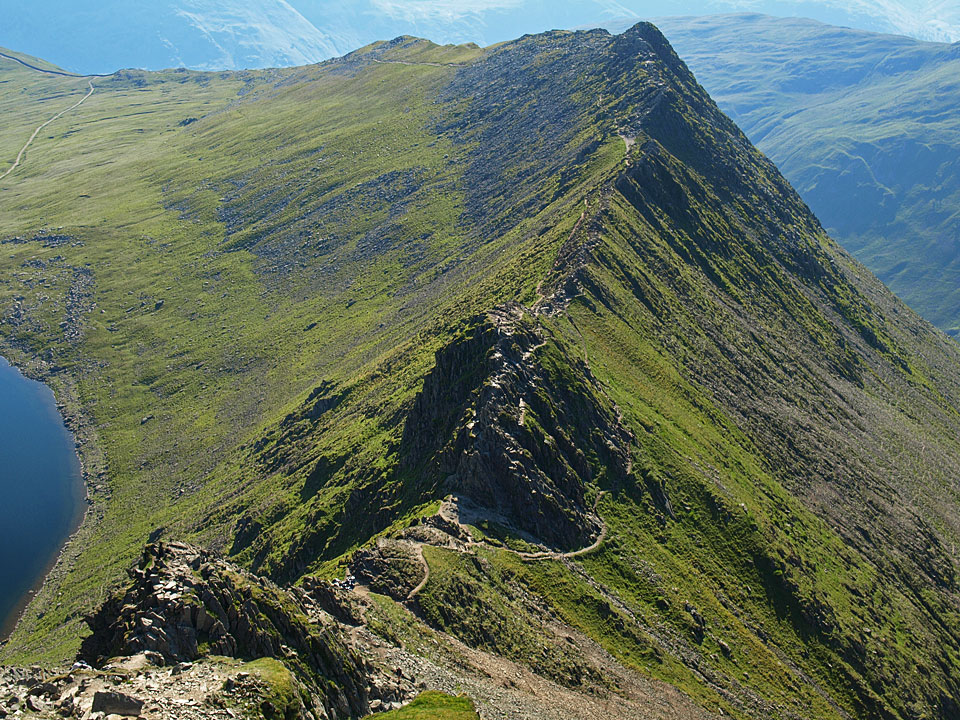
Just as in the Scouts, we were organised into patrols, groups of six, before we were allowed out on our own.  Our first excursion was as a patrol with no instructor.  My patrol was to catch a bus to Patterdale, a village near the head of Ullswater, then hike to the top of Helvellyn (3,120 feet so we call it a mountain although some might think it little more than a pimple) and on down to Glenridding, the village at the head of the lake, making a sort of U shaped route.  I thought our path to the top of the mountain was below Striding Edge, seen in the picture below, but we certainly used that route on another occasion.

Another patrol was walking in the opposite direction and we met them in a snow storm just before we reached the summit.  "Just keep going," they told us.  "You can't miss the path."

We found what little shelter there was to get out of the wind and snow to eat our lunch - Kendal mint cake, dates and a bar of Cadbury's fruit and nut chocolate - before continuing along the path.  After a while, the snow stopped and we got below the cloud line.  There in front of us was the head of the lake.

But something was wrong.

The lake should have been to our left - but it was to our right.  According to the map, there were no trees around the head of the lake - but we could see in plain sight that the area around the head of the lake was heavily wooded.  The others didn't believe me when I told them that we had missed the path and were descending the wrong side of the mountain.  Being in the minority (5 to 1) I had little choice but to go along.  Sure enough, when we reached the bottom there was a sign indicating we had reached Thirlmere.

By now it was too late to go back over the top as it would be dark long before we reached Glenridding.  We found a bus stop, hoping we might catch a bus to Ambleside and from there another bus over the Kirkstone Pass to Glenridding.  There were no more buses that day, so we thumbed a lift in a lorry.  At Ambleside, we discovered that buses didn't run from there to Glenridding so we set out to walk the several miles involved.  Eventually, one of the Outward Bound instructors in a Land Rover found us.  We were so late that search parties had been sent out and the mountain rescue team was on standby.

And I've just realised that we still haven't reached Watendlath but I've run out of time so we'll continue the journey tomorrow.

Tuesday, 1 September 2015

Wouldn't you just know it?

The bank holiday is over, the children's summer holiday is almost done and dusted, and today the weather clerk turned off the tap.

It was goodbye to this:

and hello to this:

Visibility was so much better that I could even see the Isle of Wight, more than 50 miles away.