I will get to the answer - which has nothing to do with those neighbouring Scandinavian countries - all in good time but, first, a slight diversion to discuss a perceived threat to the Cornish pasty.
Here in Europe, certain foods have... well, I'm not sure what the official wording is, but it is something like protected geographic status. What it means is that, for example, champagne is produced in that part of France from which it gets its name and nowhere else. No other sparkling wine may be called champagne. Similarly, there are three English foods that have this protection: Melton Mowbray pork pies are produced in that small market town; Stilton cheese (which, oddly enough, is not made in the Cambridgeshire village of Stilton) is made in a designated area; and the Cornish pasty, which can only be made in Cornwall.
(And I think the official wording might well be Protected Denomination of Origin.)
But the Cornish pasty is in danger. The denomination of origin protection extends only to Europe, so there is nothing to stop similar pasties made in America, to recipes carried by Cornish emigrants, being so described. So what, you might ask? There is talk of some sort of trade deal being discussed between officials in the European Union with their counterparts in Washington. If that deal comes about, there will be nothing to stop American manufacturers exporting so-called Cornish pasties to Europe. There is no apparent danger to Stilton cheese or Melton Mowbray pork pies as there are no products made in America bearing those descriptions.
So, what is this business of a swede not being a swede? Well, it all came to light about four years ago when officials of the European Union tried to decide when a swede
is not a swede but a turnip and, conversely, when a turnip is a swede. It was all the fault, as so many things like this seem to be, of the French.
Their wines have long been subject to appellation controllée
which defines exactly where the grapes for the wine were grown. They
later spread this scheme to cover cheese and, for all I know, it might
now cover olive oil as well. The original reason for this was to
protect their farmers and to prevent people from other areas or, worse,
other countries from using names such as Champagne when what they were
really describing was a sparkling wine produced in the Champagne style.
Needless to say, the Brussels bureaucrats soon jumped on this idea as a
way of expanding their own little (only now it's not so little) empire.
In order to give the Cornish pasty its PDO or appellation controllée, it was necessary to describe the recipe precisely and officially, and it was this precise description that exercised so many bureaucratic minds. You see, in Cornwall, the swede is known as a turnip. The traditional
recipe uses swede in the filling, but to a true Cornishman, it's turnip.
So the bureaucrats had to decide just what ingredients go into a
Cornish pasty - and what should be listed on the packaging. Does it
include swede or turnip? If the bureaucrats decided on swede because
that is what most people call the vegetable, the Cornish would say it's
not the proper recipe, but if the decision were to call the vegetable
turnip, people outside Cornwall would expect something different.
I never did learn what was decided, but I can answer the question in the title: when it's in Cornwall.
Wednesday, 7 January 2015

Tuesday, 6 January 2015
Rip off!
It's high time that I had a rant. I haven't had one for, ooh, ages, and if I don't get one soon, I'll . . .
Anyway. Parking charges in Brighton. After our meeting yesterday (I still have my watch and all my fingers - and, boy, is he a smooth talker!) a colleague and I headed off into the centre of Brighton to meet our solicitor. No empty meters around, so into the nearby multi-storey. This is not something to be undertaken lightly, wantonly or without first ensuring that another mortgage will be available.
£4.20 for one hour! And just to rub salt into the wounded wallet, when I came to pay, the ticket machine was not accepting notes. Coins or credit cards only. Having insufficient small change, I opted to pay by credit card - and was immediately charged a further 11p "processing fee". That's two rip offs (rips off?) in one go, killing two birds with one stone. Honestly, I have parked in the centre of Mont Carlo and Cannes at lower prices than were being charged in Brighton.
And to have the cheek to add 2.5% as a processing fee just because I paid by credit card. The cost of processing credit cards is something that should be built into the price of things, just as the cost of handling cash is.
Then we have the problem of actually paying at parking meters in Brighton. The latest news is that all parking meters will be removed within the next two years - but don't get over-excited just yet. There is a but, a BIG but. This doesn't mean that parking will be free, oh dear me no. Motorists will need to pay by phone.
Now, I know very well that many people have contracts with their mobile phone service providers allowing them so many minutes of calls each month. But what about people (like me) who simply pay for calls made - or those who top-up by buying £5 or £10 of time. Not only will we have to pay to park, but we will have to pay to pay! And if there is a credit card processing fee added on top of the parking charge we will have to pay to pay to pay to park.
I wonder, too, if any thought has been given to visitors from overseas who will have to use their (foreign) credit cards - and pay an exchange fee on top of all that!
A recent news story demonstrates just how careful one needs to be when paying by phone to park.
The motorist inadvertently paid £5,325 too much for a parking space which should have cost them just £15.30. Brighton and Hove City Council refunded the motorist after the driver mistakenly entered the location code of their parking bay as the number of hours of their stay. Lucky that there was sufficient spending power on the credit card. And I wonder how long it took to get the refund?
Welcome to Brighton - the rip-off capital of England!
Anyway. Parking charges in Brighton. After our meeting yesterday (I still have my watch and all my fingers - and, boy, is he a smooth talker!) a colleague and I headed off into the centre of Brighton to meet our solicitor. No empty meters around, so into the nearby multi-storey. This is not something to be undertaken lightly, wantonly or without first ensuring that another mortgage will be available.
£4.20 for one hour! And just to rub salt into the wounded wallet, when I came to pay, the ticket machine was not accepting notes. Coins or credit cards only. Having insufficient small change, I opted to pay by credit card - and was immediately charged a further 11p "processing fee". That's two rip offs (rips off?) in one go, killing two birds with one stone. Honestly, I have parked in the centre of Mont Carlo and Cannes at lower prices than were being charged in Brighton.
And to have the cheek to add 2.5% as a processing fee just because I paid by credit card. The cost of processing credit cards is something that should be built into the price of things, just as the cost of handling cash is.
Then we have the problem of actually paying at parking meters in Brighton. The latest news is that all parking meters will be removed within the next two years - but don't get over-excited just yet. There is a but, a BIG but. This doesn't mean that parking will be free, oh dear me no. Motorists will need to pay by phone.
Now, I know very well that many people have contracts with their mobile phone service providers allowing them so many minutes of calls each month. But what about people (like me) who simply pay for calls made - or those who top-up by buying £5 or £10 of time. Not only will we have to pay to park, but we will have to pay to pay! And if there is a credit card processing fee added on top of the parking charge we will have to pay to pay to pay to park.
I wonder, too, if any thought has been given to visitors from overseas who will have to use their (foreign) credit cards - and pay an exchange fee on top of all that!
A recent news story demonstrates just how careful one needs to be when paying by phone to park.
The motorist inadvertently paid £5,325 too much for a parking space which should have cost them just £15.30. Brighton and Hove City Council refunded the motorist after the driver mistakenly entered the location code of their parking bay as the number of hours of their stay. Lucky that there was sufficient spending power on the credit card. And I wonder how long it took to get the refund?
Welcome to Brighton - the rip-off capital of England!
Monday, 5 January 2015
If winter comes . . .
. . . can spring be far behind?
It has turned very mild today, almost spring-like. And it seems to have got to the birds. When I opened the door to let the dog down the garden in the half-light, I was serenaded by a robin in the cherry tree. It was pleasant, but robins sing all year round so I thought no more about it. But later, in the park, a wood pigeon burst into coo and as well as what seemed like a multitude of robins, I heard blue tits chattering to each other, wrens singing their song much louder than one would expect from such a small bird and several blackbirds. But the star of the show was a song thrush and I stood listening to him for several minutes.
Anyway, I've a busy day ahead. A lunchtime meeting (with fellow directors) with a man who wants to do a deal with us. We have dealt with him in the past but many of us (indeed, most of us) have learned not to trust him. Before shaking hands with him, I always make sure my watch is firmly fastened. After shaking hands, I check that I still have my watch - and count my fingers! But we still hope to recoup some of our previous loss with the proposed deal. Time will tell.
It has turned very mild today, almost spring-like. And it seems to have got to the birds. When I opened the door to let the dog down the garden in the half-light, I was serenaded by a robin in the cherry tree. It was pleasant, but robins sing all year round so I thought no more about it. But later, in the park, a wood pigeon burst into coo and as well as what seemed like a multitude of robins, I heard blue tits chattering to each other, wrens singing their song much louder than one would expect from such a small bird and several blackbirds. But the star of the show was a song thrush and I stood listening to him for several minutes.
Anyway, I've a busy day ahead. A lunchtime meeting (with fellow directors) with a man who wants to do a deal with us. We have dealt with him in the past but many of us (indeed, most of us) have learned not to trust him. Before shaking hands with him, I always make sure my watch is firmly fastened. After shaking hands, I check that I still have my watch - and count my fingers! But we still hope to recoup some of our previous loss with the proposed deal. Time will tell.
Sunday, 4 January 2015
Vegetating
The Christmas cake, the pudding, the mince pies and the brandy butter are all just memories now - but we still have some turkey left! We don't buy a turkey for Christmas, we buy a turkey crown. That way there is no carcase to dispose of - and it also makes carving just a little easier. Not that carving a whole turkey is exactly difficult. Anyway, we ate cold turkey last night, with baked potatoes and Brussels sprouts.
I wouldn't say that sprouts are my favourite vegetable, but I'm perfectly happy to eat them. There has long been an urban myth that English housewives start cooking the Christmas sprouts in about September so that they are properly softened by the time they are wanted to accompany the turkey. Absolute nonsense, of course. You can't buy sprouts in September. But many people are not especially keen on the "little green bullets". But maybe they have never tried eating them when served the way the Old Bat did them yesterday - mixed with pancetta and chopped chestnuts.
As I said, I wouldn't describe sprouts as my favourite vegetable. But then, there are lots of vegetables that would not merit that description; there can, after all, be only one favourite. I don't know what I would call my favourite. I'm bored with broccoli (which we seem to eat almost every day) and French beans are very popular with She Who Cooks. She is less keen on peas, which I do like very much, especially when picked and eaten only ten minutes later! But I enjoy frozen peas as well. I like parsnips very much - provided they are roasted. Our local Italian restaurant decorates some dishes with thin slivers of parsnip, either baked or fried, I'm not sure which, but either way, they are delicious.
Sweet corn I love, either as corn on the cob or the frozen - what do you call them? Bits? But preferably not tinned. I'm not keen on any tinned vegetables, except baked beans - which are another of the OB's less-liked vegs. Carrots, cabbage, swede, cauliflower - bring it all on!
Oddly enough, I think my favourite vegetable is probably the humble potato. It is so versatile, eaten as plain boiled potato with steak and kidney pudding, or mashed with things like boeuf bourguignon. Roasted, baked, served as chips, wedges (with plenty of mixed herbs), potato cakes or rosti.
I'll have to stop: I'm getting hungry!
I wouldn't say that sprouts are my favourite vegetable, but I'm perfectly happy to eat them. There has long been an urban myth that English housewives start cooking the Christmas sprouts in about September so that they are properly softened by the time they are wanted to accompany the turkey. Absolute nonsense, of course. You can't buy sprouts in September. But many people are not especially keen on the "little green bullets". But maybe they have never tried eating them when served the way the Old Bat did them yesterday - mixed with pancetta and chopped chestnuts.
As I said, I wouldn't describe sprouts as my favourite vegetable. But then, there are lots of vegetables that would not merit that description; there can, after all, be only one favourite. I don't know what I would call my favourite. I'm bored with broccoli (which we seem to eat almost every day) and French beans are very popular with She Who Cooks. She is less keen on peas, which I do like very much, especially when picked and eaten only ten minutes later! But I enjoy frozen peas as well. I like parsnips very much - provided they are roasted. Our local Italian restaurant decorates some dishes with thin slivers of parsnip, either baked or fried, I'm not sure which, but either way, they are delicious.
Sweet corn I love, either as corn on the cob or the frozen - what do you call them? Bits? But preferably not tinned. I'm not keen on any tinned vegetables, except baked beans - which are another of the OB's less-liked vegs. Carrots, cabbage, swede, cauliflower - bring it all on!
Oddly enough, I think my favourite vegetable is probably the humble potato. It is so versatile, eaten as plain boiled potato with steak and kidney pudding, or mashed with things like boeuf bourguignon. Roasted, baked, served as chips, wedges (with plenty of mixed herbs), potato cakes or rosti.
I'll have to stop: I'm getting hungry!
Saturday, 3 January 2015
Toys for boys
I've been deliberating with myself about going behind the scenes (as we call it) and crawling into the deepest recesses of the loft to bring out the electric train set which is - or should be - there. The grandsons are old enough now to play with it. Always assuming it can have life breathed back into it. It's not simply a train set, it is a whole model layout on a board - tunnel through a grass-covered hill, fences, trees, animals, even a small orchard of apple trees! The boys (Huh! They're both over 40 now!) and I made it years ago. And great fun we had, too.
 The train set of my boyhood was a set of eight curved rails which clipped together to form a circle, an engine and two carriages. It must have looked similar to the train set on the right - without the Meccano engine in the centre - although as far as I can recall my engine was green and had no tender, just the two carriages. It was probably listed as O gauge, although it transpired in time that it was just a tad small compared to the standard O gauge sets.
My brother subsequently saved up his pocket money (and probably birthday and Christmas presents as well) to buy himself a spanking smart engine and tender made by the famous British train set manufacturers, Hornby. This engine was another clockwork one, O gauge, and found my circular track just a little tight. Things were much improved when we bought proper Hornby track, one piece at a time; straights, half straights, curves, crossovers and even points! We also bought several wagons of different sorts. It was a little frustrating having to wind up the engines, but at least we were able to lay out the track from one room to another after we had built up our collection and the slightly different levels of linoleum and carpet made no difference to a set on this scale.
I would have loved an electric train set, but brother and I were very happy with what we had. Years later, after I had married, I was just a little envious when I learned that my wife had had an electric train set. I'm not sure that she was at all interested in it, but she was an only child and her father probably wanted one!
When the boys were old enough, I bought them the train set I had realised I would have liked as a child, a Hornby Dublo electric train in OO gauge (hence the "Dublo" in the name). This was fine, but a train set of this nature really needs to be laid out and left out - and our house simply wasn't big enough. So, in the fulness of time, another train set appeared, an N gauge set. This gauge is small enough to fix the track on a board only about five feet by three - or even smaller - and that is just what we did, constructing the imaginary countryside around the track. We were aiming at something like this, although our talent was not up to quite this level!

The train set of my boyhood was a set of eight curved rails which clipped together to form a circle, an engine and two carriages. It must have looked similar to the train set on the right - without the Meccano engine in the centre - although as far as I can recall my engine was green and had no tender, just the two carriages. It was probably listed as O gauge, although it transpired in time that it was just a tad small compared to the standard O gauge sets.My brother subsequently saved up his pocket money (and probably birthday and Christmas presents as well) to buy himself a spanking smart engine and tender made by the famous British train set manufacturers, Hornby. This engine was another clockwork one, O gauge, and found my circular track just a little tight. Things were much improved when we bought proper Hornby track, one piece at a time; straights, half straights, curves, crossovers and even points! We also bought several wagons of different sorts. It was a little frustrating having to wind up the engines, but at least we were able to lay out the track from one room to another after we had built up our collection and the slightly different levels of linoleum and carpet made no difference to a set on this scale.
I would have loved an electric train set, but brother and I were very happy with what we had. Years later, after I had married, I was just a little envious when I learned that my wife had had an electric train set. I'm not sure that she was at all interested in it, but she was an only child and her father probably wanted one!
When the boys were old enough, I bought them the train set I had realised I would have liked as a child, a Hornby Dublo electric train in OO gauge (hence the "Dublo" in the name). This was fine, but a train set of this nature really needs to be laid out and left out - and our house simply wasn't big enough. So, in the fulness of time, another train set appeared, an N gauge set. This gauge is small enough to fix the track on a board only about five feet by three - or even smaller - and that is just what we did, constructing the imaginary countryside around the track. We were aiming at something like this, although our talent was not up to quite this level!
Friday, 2 January 2015
The hole truth
After yesterday's (overlong) post I'm going to keep it a lot shorter today. That's partly because I've been on the go since first thing and it's now approaching winding down time and partly because the muse seems to have departed for other climes.
Anyway, there has been action on the hole front. I first mentioned the hole here on 20th December, and then posted an update here on the 27th, since when several things have happened. It must have been about a week ago - immediately after Christmas - that the hole outside my neighbour up the road was filled in. But the same day, another hole was dug outside my neighbour down the road - and yet another three doors further down. Every day, at least one man arrived in a van, spent some time ruminating before getting out of the van and peering into each hole in turn. After that, he would get back into his van and ruminate some more, before making a phone call and driving off.
Then, on Monday, another hole was dug, midway between the two already existing holes. And on Wednesday, as I left for the park with the dog, I noticed two vans and a flat-bed truck. I counted five men standing around not even talking or bothering to peer into any of the holes. But when I came back from the park, the truck had gone and just three men were gazing intently into the hole furthest down the hill. A fourth man was back in one of the vans, obviously exhausted from his stint of hole watching and in need of a rest.
But today, when I arrived home from the weekly visit to Sainsbury's, a grab lorry was blocking the road. The driver was shifting the soil and general muck from the verge beside the middle hole and he also dropped some soil back into the hole before movong to allow me past. And all three holes have been filled in!
Well, partly filled in. There is earth in each of them, up to a level just below the surrounding paving slabs. They still await a little more in-filling and the replacement of the paving slabs. Meanwhile, the temporary plastic fencing remains in place, together with the "Footpath Closed" signs. But at least the "Nosmo King" signs have been removed so I rather suppose we are no longer in any danger of being blown to kingdom come.
Until the next hole is dug.
Anyway, there has been action on the hole front. I first mentioned the hole here on 20th December, and then posted an update here on the 27th, since when several things have happened. It must have been about a week ago - immediately after Christmas - that the hole outside my neighbour up the road was filled in. But the same day, another hole was dug outside my neighbour down the road - and yet another three doors further down. Every day, at least one man arrived in a van, spent some time ruminating before getting out of the van and peering into each hole in turn. After that, he would get back into his van and ruminate some more, before making a phone call and driving off.
Then, on Monday, another hole was dug, midway between the two already existing holes. And on Wednesday, as I left for the park with the dog, I noticed two vans and a flat-bed truck. I counted five men standing around not even talking or bothering to peer into any of the holes. But when I came back from the park, the truck had gone and just three men were gazing intently into the hole furthest down the hill. A fourth man was back in one of the vans, obviously exhausted from his stint of hole watching and in need of a rest.
But today, when I arrived home from the weekly visit to Sainsbury's, a grab lorry was blocking the road. The driver was shifting the soil and general muck from the verge beside the middle hole and he also dropped some soil back into the hole before movong to allow me past. And all three holes have been filled in!
Well, partly filled in. There is earth in each of them, up to a level just below the surrounding paving slabs. They still await a little more in-filling and the replacement of the paving slabs. Meanwhile, the temporary plastic fencing remains in place, together with the "Footpath Closed" signs. But at least the "Nosmo King" signs have been removed so I rather suppose we are no longer in any danger of being blown to kingdom come.
Until the next hole is dug.
Thursday, 1 January 2015
2015
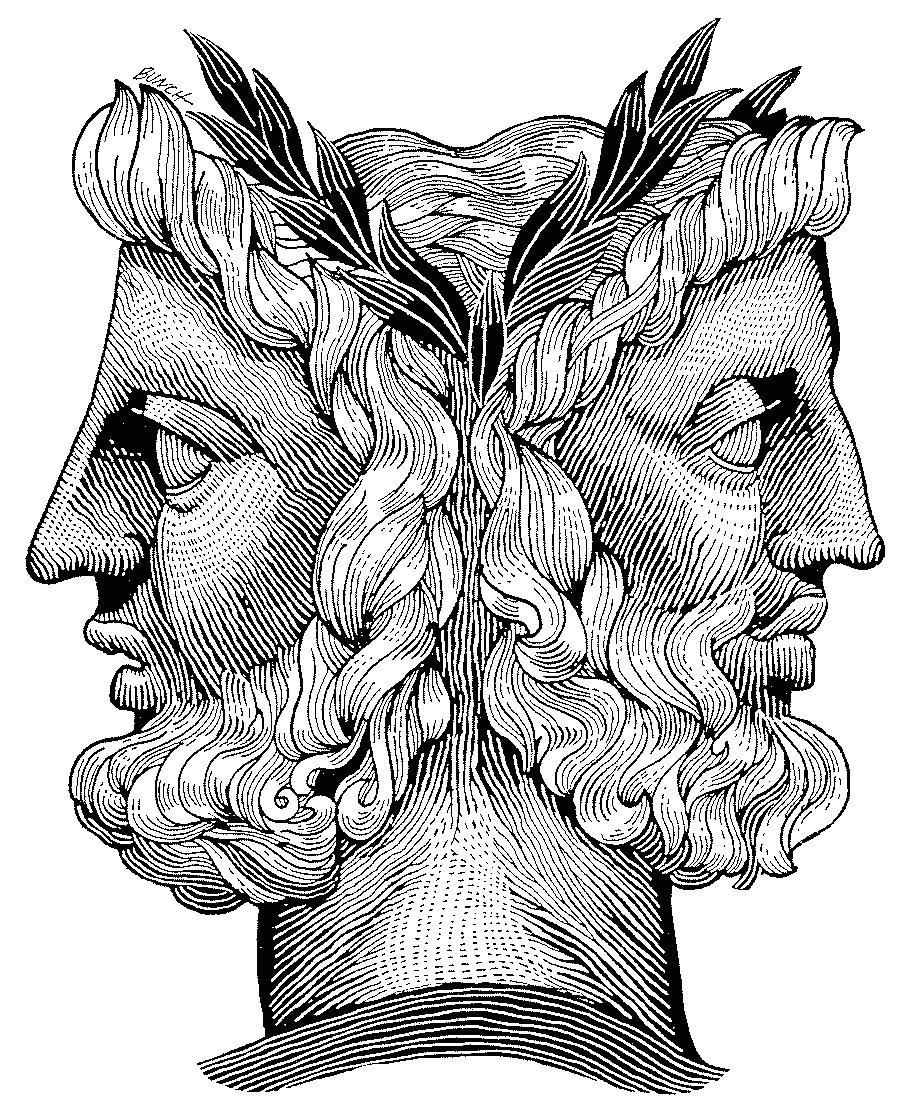
Be that as it may, I think Janus is a far better candidate for the tutelary (it's such a good word I wanted to get it in again) role. After all, this is a time for looking both back to review the year just passing, and ahead to consider what will be happening during the next twelve months so his ability to look in both directions at once would seem perfectly suited to this time of the year.
I'm not at all sure that I want to look back over the year just gone. There was too much sadness, especially during the second half of the year. All I will say is that the 70th anniversary of D Day and the 100th anniversary of the outbreak of World War I were both suitable marked. This year will see even more multi-centenaries. Three in particular mark events which had and continue to have international reverberations.
Two hundred years ago, in June 1815, the Duke of Wellington defeated Napoleon at Waterloo. This finally stopped the French dictator from grabbing power across much of Europe: he had placed his relatives on the thrones of Spain and the kingdom of Naples and was intent on bringing the rest of the continent into subjugation. the battle also ensured that Britain became the dominant colonial power for the next hundred years and more.
Another battle had been fought almost four hundred years before Waterloo, in October 1415. This, too, was fought between British (albeit in this case, English) and French armies, at Agincourt (which the French call Azincourt). The size of the English army has been estimated at 7,000 (including 6,000 archers), while the French force may have numbered between 12,000 and 25,000, the majority of these being knights. You might think I'm stretching it a bit when I say that Agincourt has caused international ripples through the ages, but just consider this: Shakespeare, in his Henry V, wrote a speech which has been read and studied by students right across the world:
This story shall the good man teach his son;Listen to it here:
And Crispin Crispian shall ne’er go by,
From this day to the ending of the world,
But we in it shall be remembered-
We few, we happy few, we band of brothers;
For he to-day that sheds his blood with me
Shall be my brother; be he ne’er so vile,
This day shall gentle his condition;
And gentlemen in England now-a-bed
Shall think themselves accurs’d they were not here,
And hold their manhoods cheap whiles any speaks
That fought with us upon Saint Crispin’s day.
Going back another two hundred years to 1215, we reach the date when King John was "persuaded" to seal the Magna Carta. In their book, 1066 and All That, Messrs Sellar and Yeatman describe, somewhat facetiously, the history of Britain. Their summary of Magna Carta reads:
1. That no one was to be put to death, save for some reason - (except the Common People).But on a more serious note, Magna Carta is considered to be the basis of democracy and justice across much of the world. the American Bar Association paid for a memorial to be erected close to the site where the charter was sealed.
2. That everyone should be free - (except the Common People).
3. That everything should be of the same weight and measure throughout the Realm - (except the Common People).
4. That the courts should be stationary, instead of following a very tiresome medieval official known as the King's Person all over the country.
5. That no person should be fined to his utter ruin - (Except the King's Person).
6. That the Barons should not be tried except by a special jury of other Barons who would understand.
Magna Carta was therefore the chief cause of Democracy in England, and thus A Good Thing for everyone (except the Common People).

And so we will be commemorating events from 1215, 1415 and 1815. It seems rather strange that nothing very notable happened in 1615!
Subscribe to:
Posts (Atom)