Tuesday, 22 October 2013

The gentle giant

I don't know what it is about them, but there are some people who make me smile whenever I see them.  One such is a man whose name I don't know but whom I see almost every time I visit a particular restaurant in Châteaubriant.  This restaurant is also run as a bar, one of the few bars in the town that stay open during the evening, and the gentleman in question is a regular drinker there.  He is a large man, both in height and girth, and his hands are like spades.  As I say, I don't know his name - we have never been introduced - but he always greets us warmly, shaking my hand and giving the Old Bat a hug and a kiss.  He has several teeth missing, is never dressed exactly smartly and frequently needs a shave.  But his round face is friendly and he takes a great pleasure in helping out during busy times.  Last week, one of the two men who own and run the restaurant was unwell.  The other was busy in the kitchen, so the gentle giant stepped in and showed people to their tables.  As we left, there were more hugs, kisses and hand-shakes before he held the door open for us and bid us "bon retour".  Those were the only two words of his that I understood, the rest being in such a strong accent that they were completely unintelligible to both of us.  But words really aren't needed, just seeing him makes me smile.

This is the restaurant.  It doesn't look too good from the outside.

But inside is much better. The food is good as well!


Meat is cooked on this charcoal grill.  (The table cloths have been changed since this picture was taken.)


Monday, 21 October 2013

The Immortal Memory

It was 208 years ago today that Admiral Lord Nelson led the British fleet - out-numbered in ships, guns and men -  to victory over the combined French and Spanish fleets, thereby ensuring the Napoleon would be unable to invade England.  Indeed, there are those who maintain that it was this victory that paved the way for Wellington to finally defeat the French at Waterloo almost ten years later.  Certainly it meant that there would be no challenge to the Royal Navy's supremacy of the seas for more than 100 years.

I am still able to recall how interesting my history teacher made this subject with his chalked diagram of the battle - similar to the picture below.


Of course, every Englishman (or nearly every Englishman) can quote Nelson's famous signal:


Many naval institutions hold Trafalgar Night dinners.  According to the Royal Naval Museum Library,
The Loyal Toast: Diners should stand - unless the company are naval officers who are specifically authorised to remain seated. The toast itself, by Royal decree, is "The Queen".
The Immortal Memory toast: A Trafalgar Night speech is usually made by a guest of honour. If a speaker has not been arranged, the proposer of the toast will precede it with some Nelsonian comments, and can vary in length according to the custom of the diners. The toast itself is "The Immortal Memory" and is drunk standing in total silence. This is customary out of respect of the memory of the Admiral.

Sunday, 20 October 2013

That reminds me

Seeing that phone box in Pouancé (I mentioned it yesterday) reminded me of a holiday we had once in Malta.  Or should that be on Malta?  Anyway, we were staying in Valletta and fancied a country walk.  So, we caught the bus to a small village down the coast and set off, following footpaths in the general direction of a tourist attraction known as the Blue Grotto.  We had remarked on how quiet it seemed with not a single bird to be seen or heard when it dawned on us that all the birds had left to avoid being shot, shooting being one of the main sports on the island.  Not that the absence of birds has any bearing on anything at all, really.  I just threw the comment in as a sort of make-weight.

Now, Malta - as you probably know - is quite a small island in the Mediterranean Sea between Italy and the north coast of Africa.  It was for many years a British colony or dependency or some such so it would not have surprised me to see a telephone box.  What did surprise me was to spot, seemingly abandoned in a field, a dustcart painted in the Brighton Council livery.

It was during that holiday that I had one of those "wow" moments.  We had taken a ferry across from Malta to the smaller island of Gozo and walked up to the main town, Victoria.  As we strolled through the apparently deserted narrow streets of the town, we heard a snatch of music.  Children, young children, were singing a song from The Sound of Music, "Doh, a deer, a female deer".  We walked on, attempting to track down the source.  Eventually, we found ourselves outside the open window of the local primary school where the children were having a singing lesson.  To hear that sound in those narrow streets, otherwise silent, was almost magical.

On the bus back from the ferry to Valletta, we were near a group of German tourists, one of whom was sitting at the front and showing much interest in the bus and the driver.  At the terminus, he explained that he was a bus driver in Germany.  He said that he noticed the speedometer wasn't working.  The driver explained that he didn't need one as there are no motorways on Malta!

~~~~~

At the Kingston roundabout on the A27 dual carriageway stands a burger van.  The owner uses an old toll booth as a store.


Saturday, 19 October 2013

Cherchez la femme

Or rather, cherchez le bibiotheque.  The owner of the restaurant in the French village where we have a hideaway is always keen to suggest outings we might enjoy.  These are usually nothing to our liking, often being things such as car boot sales.  (I wrote a bit about him here.)  On this occasion, he suggested we might like to watch a game peculiar to Haut Anjou, boules de fort.  This, Nicholas assured us, is completely different from petanque, or boules as it is often called.  And so it is, as you can see from this short video clip.


Nicholas told us that this is played in Pouancé, the nearby town, every Sunday at a court behind the library.

Neither the Old Bat nor I could recall ever seeing a library in Pouancé or signs indicating where it might be hidden, so the very next morning, after I had visited the boulangerie, I set off to seek le bibliotheque.  It was not marked on the street plan in the centre of town, although seemingly every other vaguely public building was indicated, so I drove the streets looking for clues.  I had no luck whatsoever.  However, I did spot a red English telephone kiosk like this

in somebody's back garden.  I also found this impressive drive leading to what appears to be a pretty large residence.  Impressive, no?


Friday, 18 October 2013

A challenge

When we see a tumble-down house as we drive through the lanes and villages of Haut Anjou, the part of the Pays de la Loire where "our" village is situated, either the Old Bat or I will sometimes remark, "Now, there's a challenge!"  Indeed, we have seen quite a few houses that would present challenges not insurmountable to fit DIY enthusiasts - which would rule me out on two grounds.  One of those potential challenges is in a hamlet just half a mile or so from "our" village.

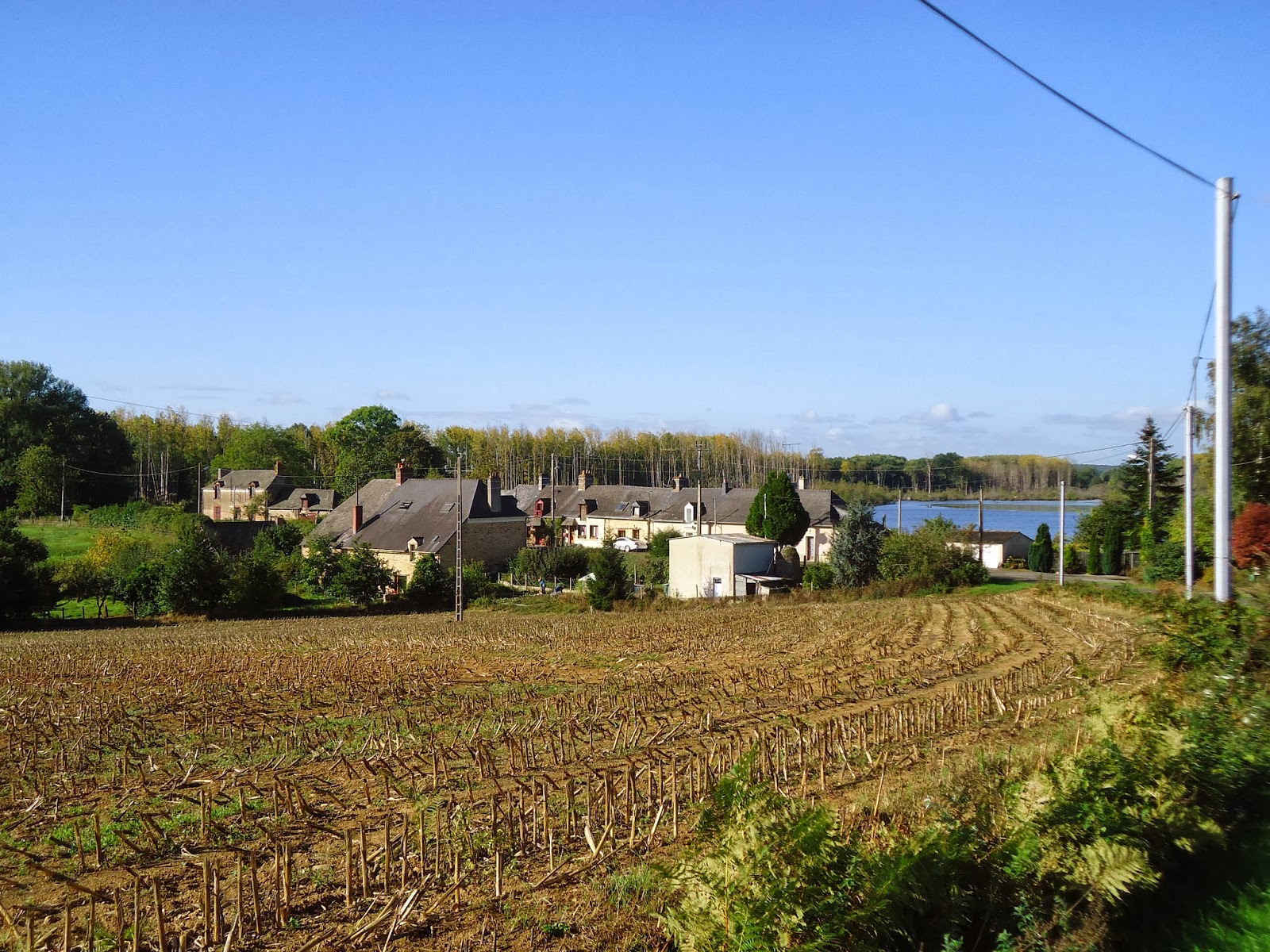
 Le Fourneau, as the hamlet is called, consists of three fairly modern, detached houses and two rows of tiny cottages facing each other, three on one side of the road and four (or are there five?) on the other.  There is also one other, old, detached house, cosiderably larger than any of the old cottages.


It must have been about nine years ago that we first saw this house.  It was empty then and has remained so ever since.  Our first thought on seeing it was that it possessed great potential, even though it was something of a challenge back then and is more so now.  There is a small garden at the back which slopes gently down to the lake.  I took this picture standing in the garden.

Thursday, 17 October 2013

A pity

One thing that is seen in France which I don't think I have ever seen in England is a house left to decay and, eventually, fall down.  This is a surprisingly common occurrence with older properties and size seems to have no bearing on the matter.  The Old Bat and I have watched this house as it has gradually given way to old age and the elements.


It looks as though it must have been a beautiful house at one time.

This cottage, in the same village as the large house above, is now almost invisible having collapsed further and become overgrown by brambles and other weeds.

I understand that this is often the result of the inheritance laws in France.  When a person dies, the law requires that the estate be divided between numerous relations.  A house can then be owned by six, seven or more people and if they can't agree on what to do with it, it just stands there deteriorating.

Wednesday, 16 October 2013

1066 and All That

When we go over to our hideaway in France, we drive there by one route and back home by another.  There are two places I always look out for, one in each direction.  Coming home, via Rennes, Caen and Pont de Normandie (which is just outside le Havre) we pass by a village called Corps Nud - which does, quite literally, translate as "naked body".  I keep meaning to make a short detour just to see, but always spot the turn off a fraction too late.  In the other direction we go via Rouen, le Mans and Laval and although we don't see the village itself, I always smile when I spot the signpost to Sillé Guillaume.  "Guillaume" is the French way of spelling William, but what "Sillé" might mean, I have no idea.  But it always reads to me like "Silly William".  I do quite often wonder what it would be like to give my address as either Naked Body or Silly William!

Silly William brings me back, admittedly by a slightly roundabout route, to the title I have ascribed to this morning's meandering thought processes.  "1066 and All That" is the title of a book purporting to cover the entire history of England.  The blurb (which I have copied shamelessly) states: "A Memorable History of England, comprising all the parts you can remember, including 103 Good Things, 5 Bad Kings and 2 Genuine Dates".  It is many years since I read the book but I seem to remember that the authors considered that the real history of England started in 1066, nothing that happened before that date being of any consequence.

1066 is possibly the only historical date remembered by many English people.  It was in that year that William, Duke of Normandy, crossed the Channel to claim the English throne.  To do so, he fought and beat Harold at the Battle of Hastings.  Harold was killed by an arrow which hit him in the eye.  That is possibly the entire history of England as known by many people.  Indeed, I knew little more than that until last week - despite having seen the Bayeux tapestry.  But while waiting for the Old Bat to emerge from the ladies', I was glancing at a tourist information leaflet written in both French and English and it gave the actual date of the battle - 14th October.  

(My old granny used to say that you learn something new every day, die and forget the lot.)

It made me realise just how little I do know about the history of my country.  I know nothing about the Crimean War, for example, other than the fact that it was fought in the Crimea, the Charge of the Light Brigade and Florence Nightingale.  I really must do some studying!

~~~~~

On our way, we pass quite close to this farm, which I always think looks an attractive group of buildings.  Pity it's so close to the motorway.